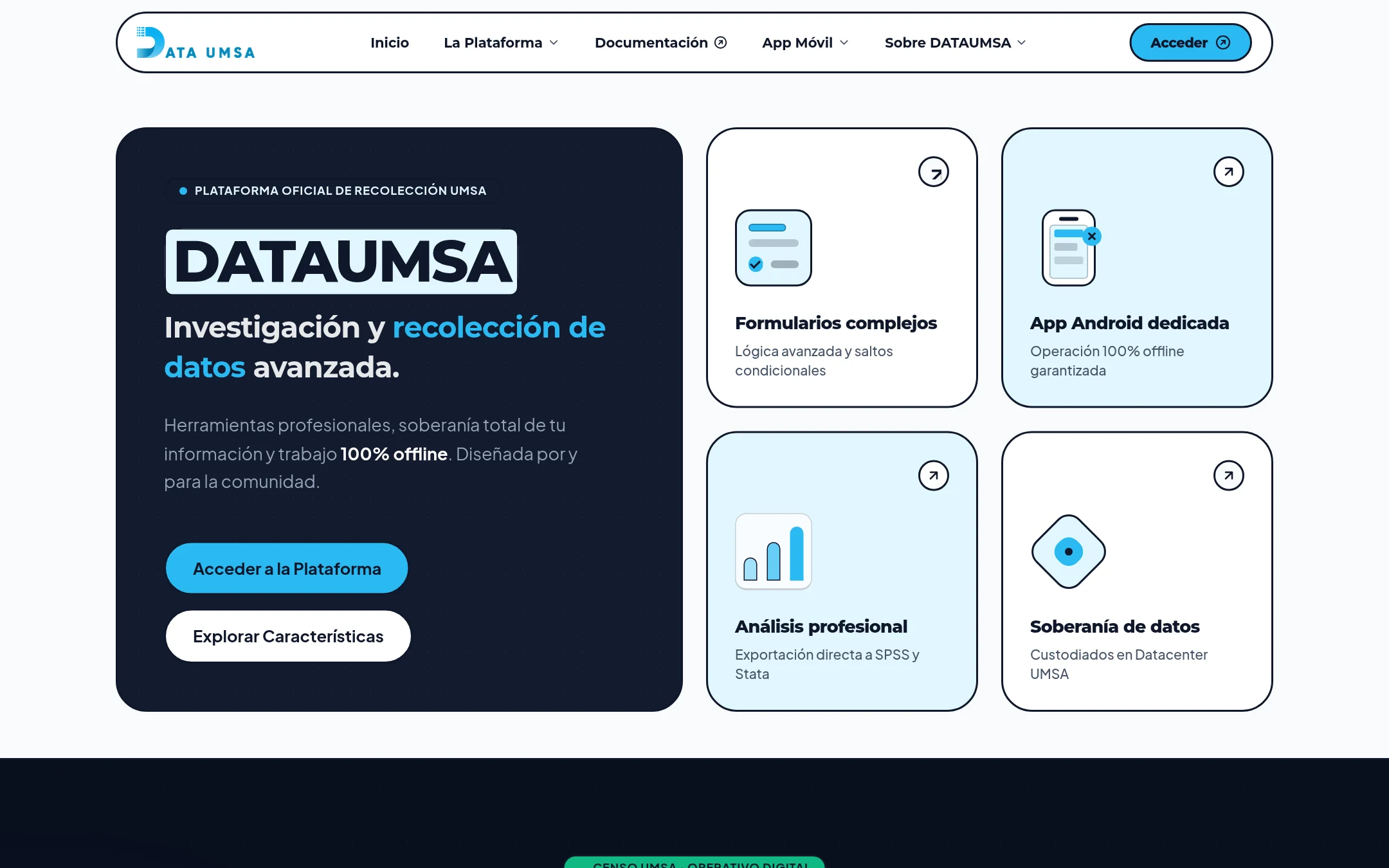
Homepage built with Astro 7 featuring Bento-style architecture and university-wide ecosystem presentation.
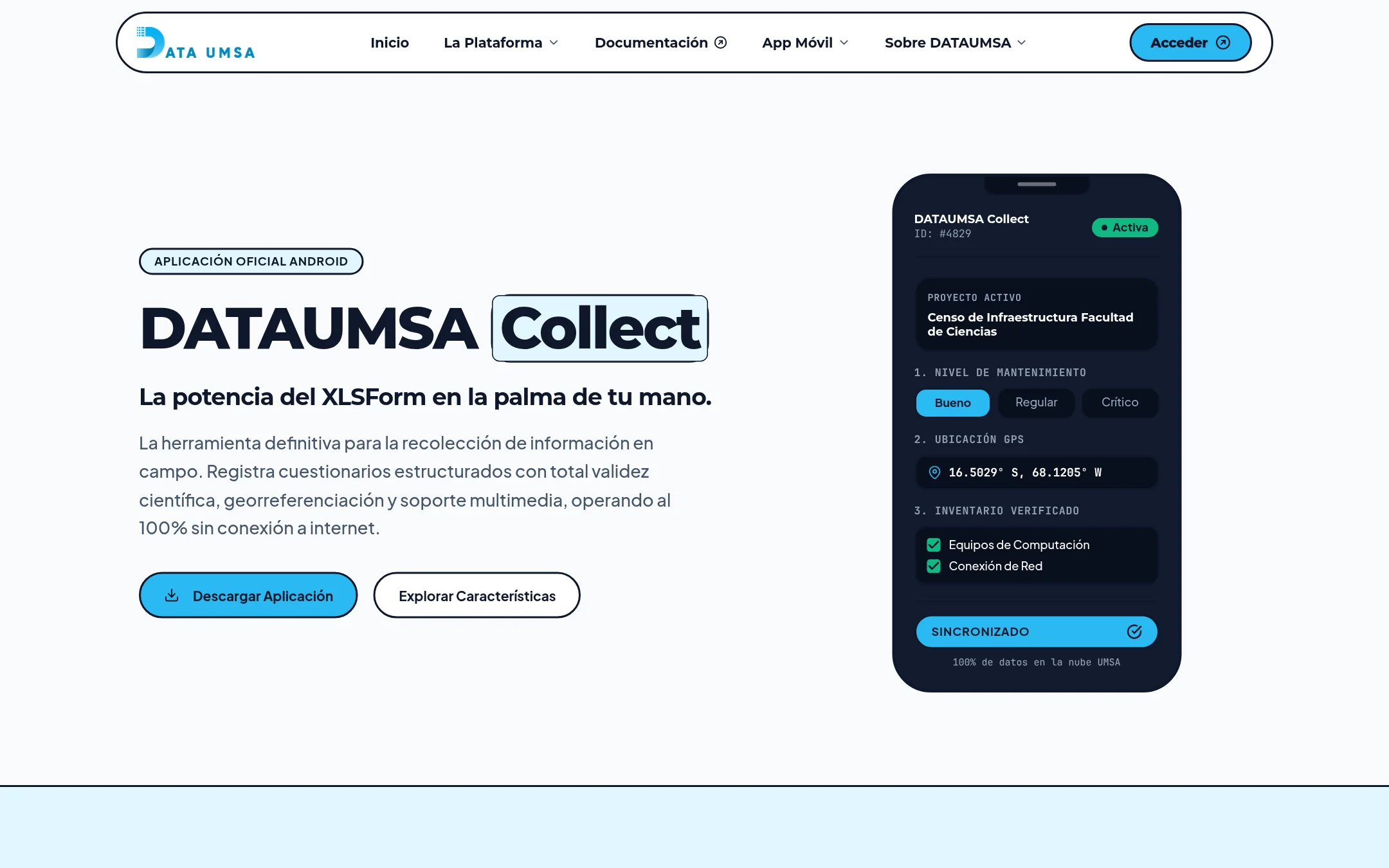
Native mobile app adaptation for field surveyors with offline data collection, GPS coordinates, and media capture.
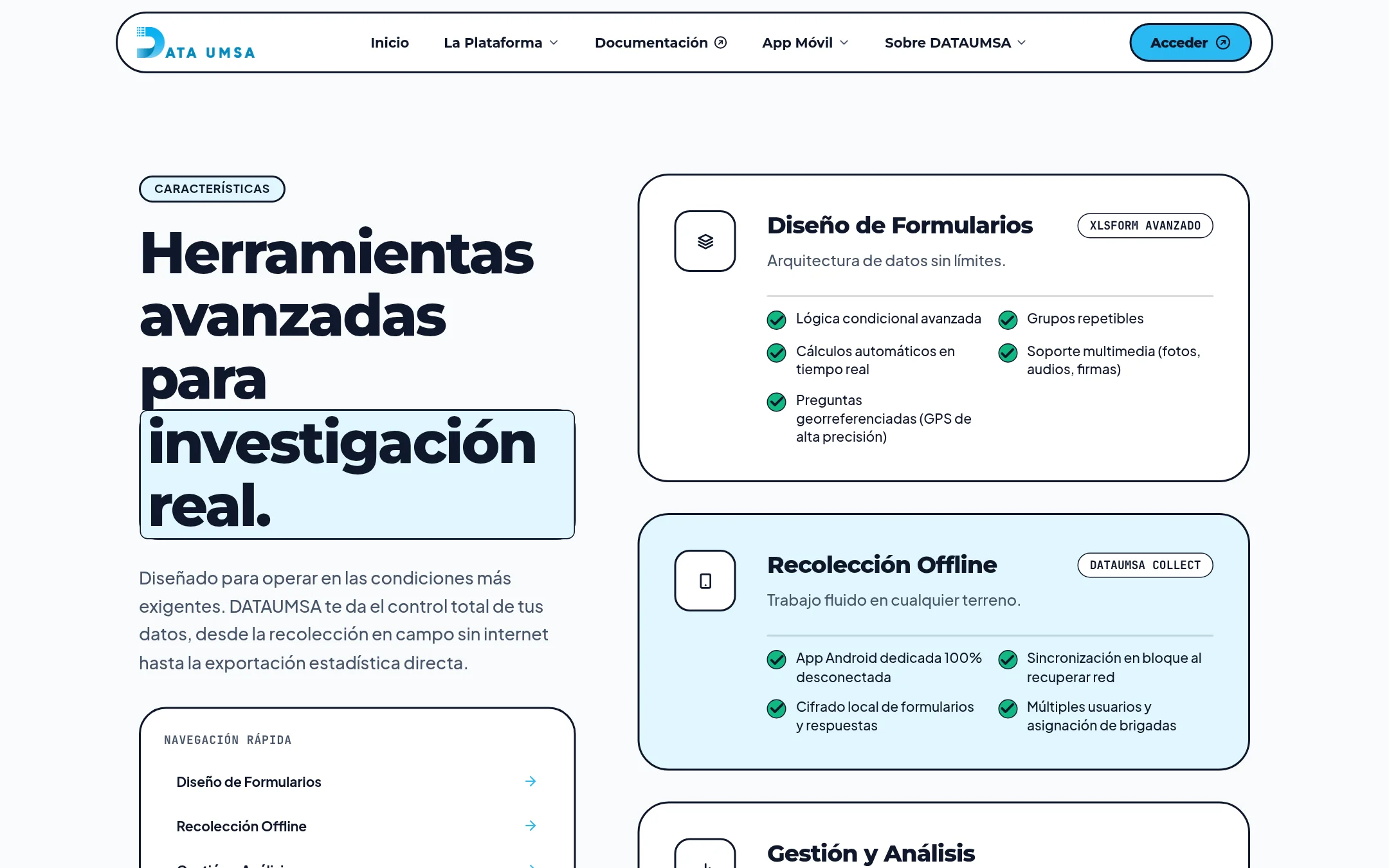
Workflow showcase: visual form builder, quality control auditing, cartography, and real-time data submission tables.
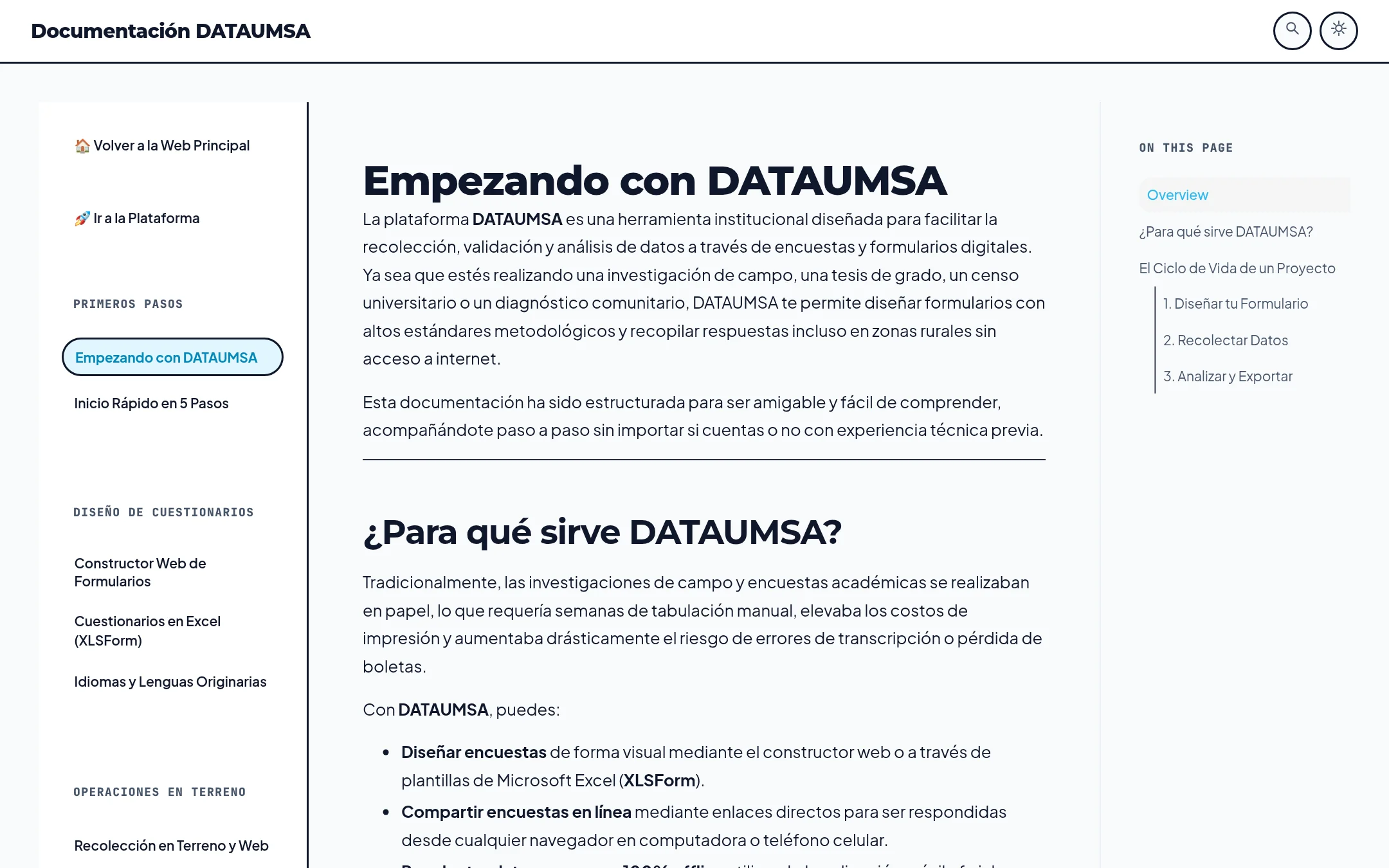
Technical and methodological documentation hub powered by Astro Starlight, XLSForm guides, and surveyor manuals.
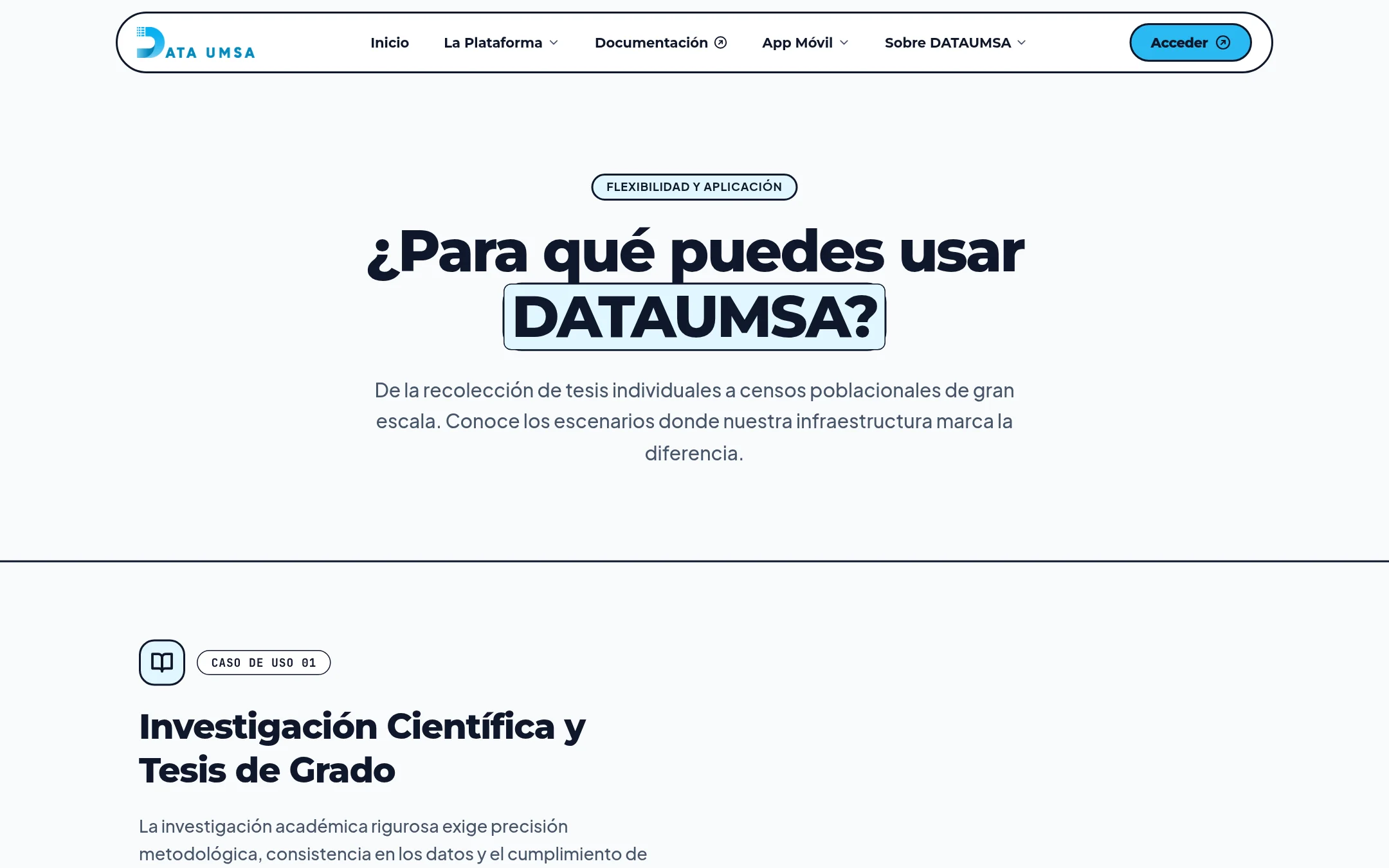
Practical applications across academic departments, field social research, and institutional census operations.
Executive Summary: Problem, Solution & Results
| Dimension | Project Insight |
|---|---|
| Institutional Challenge | Lack of a unified, sovereign data collection infrastructure across university faculties, causing heavy reliance on manual paper surveys and disparate commercial tools prone to data loss. |
| Engineering Solution | Unified research ecosystem: institutional Astro 7 portal with Starlight documentation, native Kotlin/Android mobile app with offline GPS collection, and containerized Docker orchestration with PostgreSQL. |
| Measurable Impact | Officially approved at faculty level, data transcription lead times cut from weeks to minutes, offline fieldwork capability in rural areas, and primary technical foundation for the UMSA University Census. |
1. Centralizing University Field Data
Fragmentation and Unadapted Tooling
Historically, the Universidad Mayor de San Andrés (UMSA) lacked a centralized system for field data collection. Individual departments, research institutes, and student initiatives relied on paper surveys or disparate commercial accounts. While KoboToolbox is an industry standard for humanitarian and academic field work, its vanilla installation felt disconnected: it had no university branding, user guides were not tailored to local workflows, and the mobile client lacked institutional recognition.
Operational Impact in the Field
Running research projects without unified tooling created well-known friction: weeks spent manually transcribing paper surveys, preventable data entry errors, and difficulties collecting GPS coordinates or photos in rural areas without mobile coverage.
The DATA UMSA Ecosystem
As Frontend & Mobile Developer, I led the comprehensive development of the official web portal, the adaptation of the native Android mobile client, and the cross-platform design system to deliver a sovereign, dependable, high-velocity data platform for the university:
- Cross-Platform Bento Design System: Crafted and implemented an institutional modular visual language (Bento Grid) in high-contrast primary cyan (
#29b9f2) and deep petroleum blue (#090f1e) complying with WCAG AA accessibility, synchronized simultaneously across Android XML/Compose, Tailwind CSS v4 tokens in Astro, and Mantine theme primitives in React. - DATAUMSA Collect (Native Android SDK): Recompiled and refactored the native mobile app based on Android SDK (Kotlin and Java), engineered for 100% Offline-First operations with local SQLite caching, high-precision GPS georeferencing, digital signatures, audio, photos, QR-code project auto-setup, and resilient background synchronization. Distributed via direct APK downloads for field brigades.
- Management Console & Analytics: Adapted the administrative web interfaces using React, Mantine UI v8, and Leaflet for authoring dynamic questionnaires, inspecting tabular submission audits, and visualizing territorial maps.
- Documentation Center & Knowledge Hub: Built the official knowledge hub using Astro 7, Starlight, and Tailwind CSS v4, featuring downloadable XLSForm templates, field manuals, and reporting guides for business intelligence tools like Power BI.
- Data Sovereignty & Governance: Self-hosted on university-owned bare-metal/Docker infrastructure, completely preventing sensitive academic and institutional data leakage to offshore third-party servers.
Ecosystem Technology Stack
Official institutional web portal and technical documentation center powered by Starlight.
DATAUMSA Collect native mobile client for offline field surveys with GPS telemetry and SQLite.
Interactive UI components for form building, submission tables, and metrics dashboards.
Modular Bento design system utilizing institutional cyan and petroleum blue palettes.
REST APIs (OpenAPI), user role administration, survey orchestration, and relational persistence.
Containerized microservice orchestration spanning KPI, Enketo, databases, and reverse proxies.
Relational persistence engine enhanced with geospatial and topological extensions.
2. Architecture and Implementation Highlights
Bento Design System and Touch Ergonomics
The platform required a welcoming experience tailored to diverse user demographics—from field surveyors to senior research directors:
- Accessible Color Hierarchy: Enforced color palettes complying with WCAG contrast thresholds exceeding 4.5:1 on all interactive touchpoints, optimized for direct sunlight legibility.
- Responsive Touch Targets: High-density summary cards on desktop monitors balanced with generous interactive targets (minimum 48px) for comfortable field surveyor operation on mobile devices.
Offline-First Resilient Operations in the Field
During fieldwork in peri-urban or rural regions of Bolivia, cellular data coverage is frequently absent or intermittent:
- The mobile application persists forms and submissions within an embedded local SQLite database.
- Surveyors execute complex logic jumps, conditional display patterns, and mathematical validations without connectivity.
- Once a Wi-Fi or cellular network is detected, submissions synchronize in the background with exponential retry policies and duplicate UUID prevention.
Knowledge Transfer with Astro Starlight
For an institutional data platform to achieve sustained adoption, accessible documentation is vital:
- Implemented a static documentation hub featuring near-instant load speeds and client-side full-text search.
- Supplies downloadable Excel templates (XLSForm), surveyor checklists, and guides for live dashboard reporting in Power BI.
3. Project Status & Production Impact
- Faculty & Staff Census (+1,000 Verified Submissions): The web platform was deployed in production for the university’s digital institutional census, successfully gathering, auditing, and processing over 1,000 complete institutional records.
- Projected Student Scale (+60,000 Surveys): The architecture was load-tested and sized to support the entire UMSA student body (more than 60,000 students, at 1 survey per student), coordinated via distributed field brigades (~10 brigades of 3 surveyors).
- Faculty Approval: Officially presented and ratified by academic faculty boards as a standard platform for research data collection.
- Under Review by the HCU: Currently in review by the Honorable Consejo Universitario for full institutional integration across all 13 faculties.
- Sovereignty & Cost Savings: Achieved 100% elimination of third-party cloud survey licensing costs while retaining complete data governance within university-managed servers.